Showing posts with label TMWWBK. Show all posts

Wednesday, June 17, 2026

TMWWBK: Battle of Isandlwana

When Eugene was playing the Indian Mutiny game I hosted in January, he felt frustrated ("in a good way") by how the mutineers were pinned down by fire and could not reach the British lines. It occurred to him then that the game mechanic could be used for a game of the Battle of Isandlwana, which he had the figures for, in 10mm.

We continued the discussion after the session, exchanged many messages over the following weeks, and soon we had a plan. I modified the cork hills I had in my collection to represent Mount Isandlwana, made a few paper bell tents and a flag base, while Eugene painted up more Zulus, and in March we ran a multi-player game for seven players at Elias Community Centre, which was documented by Eugene in the video below:

Do check his channel out for more videos, and subscribe for future videos.

Monday, April 13, 2026

TMWWBK - Getting Away with It

The British camp by the Nile

For our April game, we played another game of The Men Who Would Be Kings, this time in Epic (13.5mm) scale using Rafael's beautifully painted figures, and this time using measurements instead of grids.

The genesis for this game came when I learned that Rafael has an Epic scale Napoleonic Ottoman army, a British army, but not a French army. I wanted to run a game using his armies, and recalled a scenario from Battlegames' Tabletop Teasers compilation that featured the French army looting an Egyptian site and the Ottoman and British trying to stop them - well, who's to say the British couldn't do a spot of looting themselves after seeing off the French?

I floated the idea to Rafael, and he got onboard, printing, assembling, and painting a ketch (that would end up doing sterling service in the game) just for the scenario. I made a few simple river barges (from wooden boat models bought off Shopee), tents, painted up a half-buried sphinx (snapped off an aquarium decoration also from Shopee), and based some palm trees (again Shopee) onto cork sheets, to which I added tufts to represent reeds - I thought they didn't look half bad placed against the river terrain piece.

Ottoman forces surge towards the British camp in the middle of the table

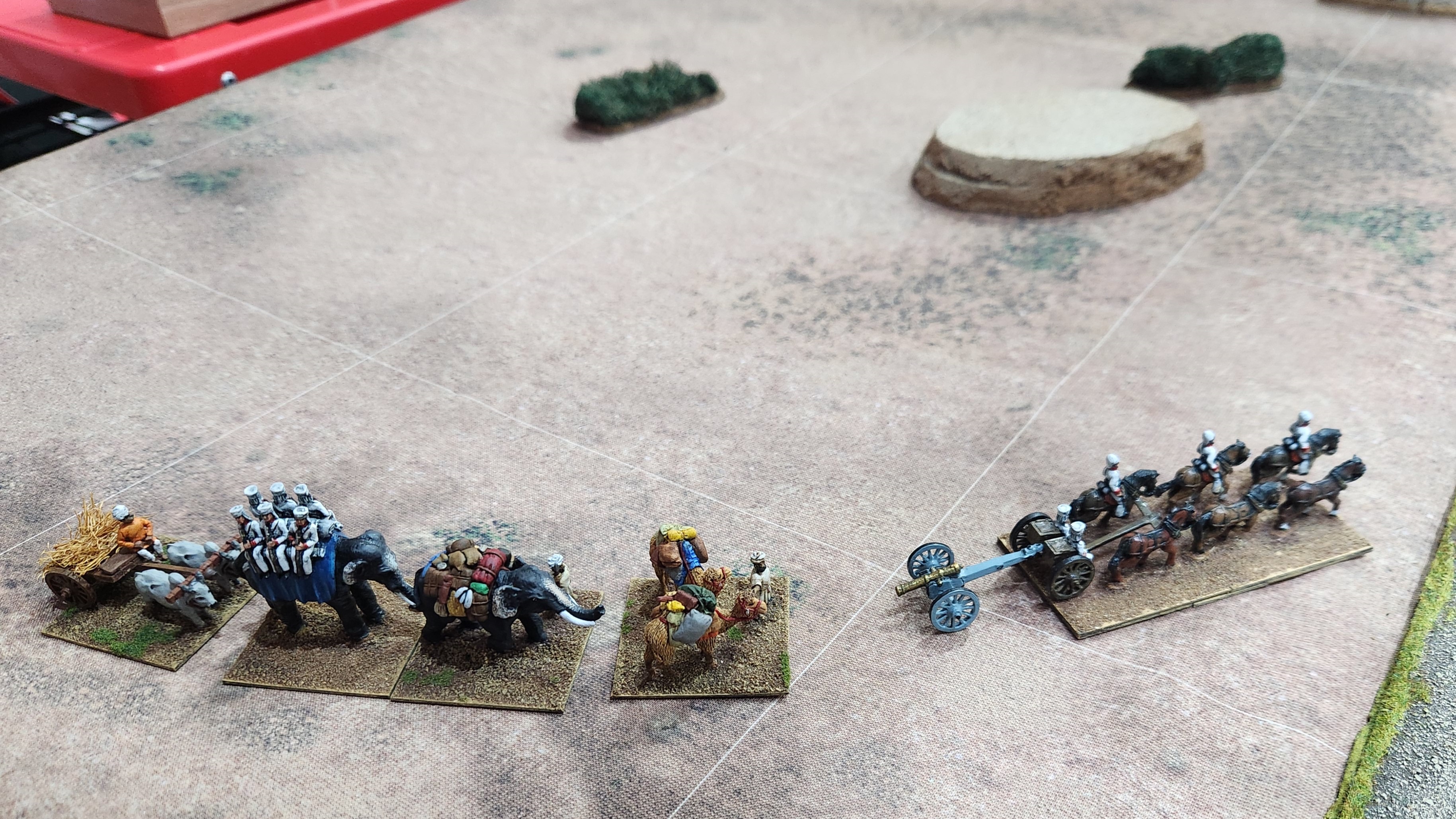
The British started the game divided into two parts, one in the centre of the table at the dig site, from where they must drive two wagons loaded with loot to the riverbank, where the other half of the British forces are. Docked at the riverbank are barges, and a ketch with howitzers.

The Ottoman forces are also divided into two parts, with one representing the professional and household troops of the local lord, and the other the local tribal forces.

To add randomness to the game, I forsook grid movement and returned to the tape measure, giving the wagons a move of 2d4 per turn. The random movement distance, coupled with the activation rolls and random move distance when units move At the Double, added suspense to each turn.

Ottoman Irregular forces

British forces hold off the Ottoman

Home stretch!

It was a close game, with the British successfully loading both wagons of loot onto the barges with the Ottoman Janissaries just one move away.

This is definitely one scenario I would like to run again.

Sunday, January 25, 2026

TMWWBK - Siege of Delhi

Sabzi Mandi, the village from where the mutineers will launch their attack

For our second game in January we played a game of The Men Who Would Be Kings. I chose the Hindu Rao's House scenario from the Colonial Conflicts scenario book, but modified the scenario rules to fit the figures I had, and to make things more interesting for the players.

One major change I made was to convert the rules to grid-based for this scenario. I reasoned that for the mutineers, there were really just three points of interest, which formed their victory objectives. For the British, I gave them the primary objective of defending those three points, and a secondary one of capturing a "spawning point" for the badmash, which could be "recycled" indefinitely. The spawning point was a temple (represented by a mosque building in the game) which was located in the built-up area, which I decided could be represented by a number of grids which could be used to determine combat. This gave the British player an option to try to capture the grid to stop the endless flow of badmash units, instead of just sitting at their positions and shooting throughout the whole game.


The mutineers mass for their attack on Delhi Ridge

The battle started a bit slow as, despite their numbers, the mutineers rolled poorly on the activation rolls and could hardly threaten the British. At the same time, the British could pick their targets tactically, choosing the unpinned units while ignoring the pinned ones, which again had difficulty rallying.

By the end of 12 turns, which was the planned game length, the mutineers were far from achieving their objectives. We decided to let the game play on, and the weight of numbers begin to tell. This prompted the forces on the far side of the table to sally forth to support their beleaguered comrades, and indeed the Gurkhas to sally forth from Hindu Rao's House. With no turn limit, it was a matter of time before the mutineers were victorious.

The Sirmoor Battalion sally from Hindu Rao's House

In retrospect the activation roll of 8+ (7+ if a general was in the same grid) proved too punishing - one sepoy unit did not make a successful roll throughout the whole game! At the same time the stacking limit of two units per grid meant that the mutineers suffered a congestion at the foot of Delhi Ridge, which available units unable to press the attack as pinned units were occupying the grids in front of them. If we were to replay this scenario, I will probably increase the stacking limit to three.

Wednesday, January 08, 2025

A Trio of Terrain Projects


We begin this year with photos of a few terrain projects I have been working on.

The first of these is an "Afghan fort" style building in 15mm which I must have acquired more than two decades ago. I cannot remember who made it, but I doubt it is still in production. It sat in the same box as my adobe buildings all this time, until my renewed interest in the Indian Mutiny made me dig it out again. I decided that it needed to sit on an elevation, and made a low hillock out of cork coasters, including steps which wound its way up. I then textured the hillock, and painted it to match the arid mat which I would use the piece with.


Hopefully it will see some action soon.

The second of these are some cardstock buildings from Paper Terrain, which I bought and built last year when I was planning an Epic scale ACW project. The cardstock isn't really thick, but when based on a stiff base, they look durable enough.


A couple of the buildings were a little trickier to assemble, but they do add interest to the tabletop.


The final one of these is the East Gate of Moria terrain piece. The inspiration for this was Midgard heroic Battles, which I couldn't resist buying. I already own many dwarves and Moria goblins, so naturally my thought turned to the war between these two races as described by Tolkien in the appendix to The Lord of the Rings. The final battle of Azanulbizar took place outside the East Gate of Moria, where Azog slew Nain in single combat, and was in turn slain by Dain Ironfoot. The account of the battle seemed to be exactly the kind of battle Midgard is written for.

I decided to make terrain piece depicting the East Gate of Moria, consisting of an elevation, a gate, and maybe a mountainside. It turned out FG already has a resin dwarven gate/arch, so I was spared the effort of making one. I made the base using corrugated boards, then textured, painted, and added vegetation to it to match the mat we would use it for. Finally, I printed a picture of a dwarven-style gate I found on google and blu-tac'ed it to the arch.

FG and I tried the rules earlier this week, and we plan to run it for the gang later this month, so stay tuned for the battle report.

Saturday, December 21, 2024

Games Expo 2024

After making contact with another wargaming group during a convention in October, we were invited to put up a game for their own convention in December. Martin and I decided to attend and reprise the Indian Mutiny game FG and I ran in the previous convention, since we already had the scenario and charts ready.

Once again we managed to run two sessions, and although the British came closer than ever to winning, victory continues to elude them!
 

The convention featured other games, including an A Song of Ice & Fire tournament, many boardgames, and a few RPGs, but the centre-piece of the convention was a giant Bolt Action Bastogne game which ran for some eight hours. 

Martin and I made more new friends, and no doubt more gaming will come from these meetings.

Monday, October 28, 2024

The Men Who Would be Kings at Campus Game Fest 2024

Other than my usual home RPG group and my wargaming group, I have been gaming off and on with a public gaming group at a community centre these past few years. The group plays mainly RPGs and boardgames, and some Battletech Alpha Strike; I run the occasional one-shot RPG there, and play the occasional boardgame.

This year, the group was invited to take part in a games convention at a school, and I was invited to put up a historical wargame there.

This was when I realised that, while I do have many paired armies, most of them are sci-fi or fantasy, and the historical armies that I do own both sides of are not painted by me, but cobbled together from various ebay purchases. The only armies which look presentable are my Indian Mutiny forces, which were mostly painted by a single painting service.

Now while I do enjoy The Relief of Luckpore, I thought that a grid-based wargame would not be a good representation of most historical miniature wargame, so I went through to my library and decided on Dan Mersey's The Men Who Would be Kings, which I helped playtest with these same figures in 2015.

I modified the command rules a little to allow for five players - two on the British side and three on the Mutineer side - with three units each. I picked out a scenario from Colonial Conflicts: The Indian Mutiny, adjusted the set-up to fit, and with the help of a few friends tested the scenario, made some adjustments, and we were ready.

The set-up

Civilians in the village

The British train

We were scheduled for 4pm to 9pm, and I imagined that gave enough time to run two or maybe three games, each with five players on each side and FG and I umpiring. As it turned out the crowd were mostly there for the e-games and card games, and we didn't draw much attention apart from the other miniature wargamers who were there. One of them played the mutineers against me, and beat me resoundingly with incredible dice rolls.

We then had a student of the school walk by and he decided to take a swing at playing the British. He had better luck than me, and almost made it to the mutineer lines before his luck ran out.

The situation at the end of the second game

Over all the amount of gaming we did out of the session was probably not worth the effort of preparing the charts and cards and traveling down, but I did make friends with some historical wargamers and we might be getting some gaming in in the future, so that made the whole evening worthwhile.