Sunday, May 18, 2014

X-Wing and Pak 38

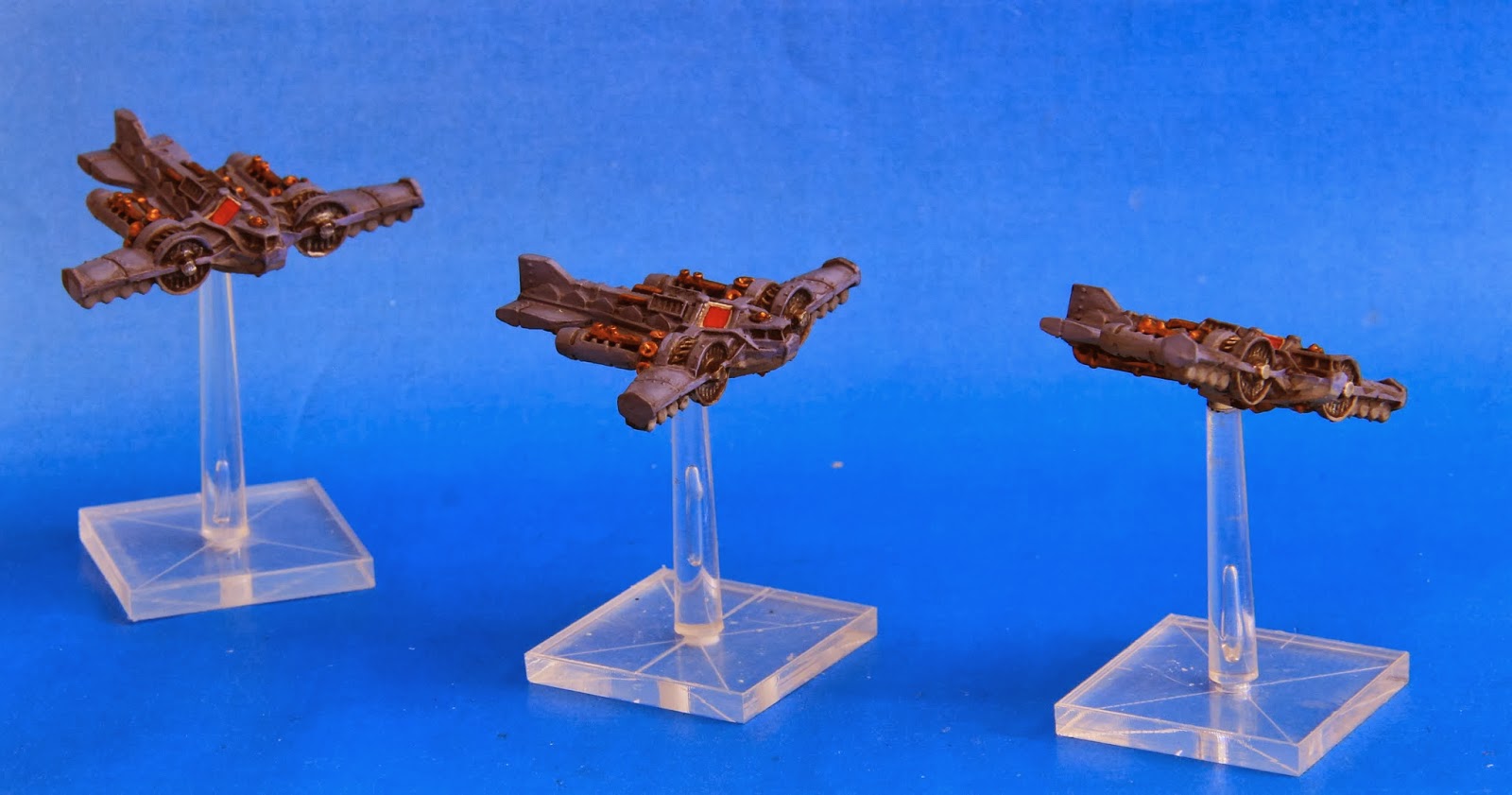
fg came over for a game of X-Wing and we used the new star mat that he bought.

Rebel and Imperial forces duke it out in an asteroid field.
He chose a mat with a hex grid as our other starship game of choice is Starmada Compendium, which uses hexes.

My order from Plastic Solider Company arrived earlier in the week, but unfortunately there was a mistake with the order, which means there will be a few week's delay in our planned campaign. Nevertheless, I thought I should just work with what I have on hand and continue to build up my terrain collection.

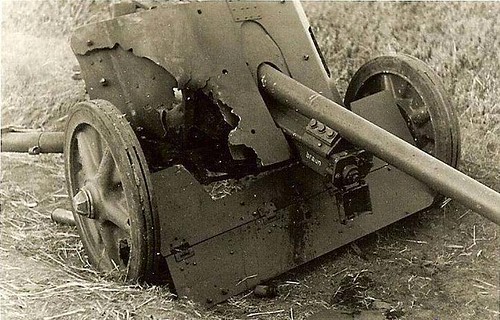
The PSC Pak 38 box comes with four guns, so after assembling one and passing two to fg in case he decided to start a German force, I thought I would make a wrecked gun as a terrain piece. I thought I would make it a "realistic" terrain piece and base it on a photo of an actual destroyed Pak 38 gun; turns out those aren't common on Google (most are actually of restored guns or of the crew in action, taken from the rear or side). I did manage to find one photo on flickr (sorry, I didn't note down the user):


Here is my attempt to duplicate that in 20mm:


I think I didn't do too badly, although I wonder if I should remove the rivets on the right side of the gun shield, which appear to have popped off due to the impact of the round.

Should be fun to paint, this.

Tuesday, May 13, 2014

More CoC Terrain

Work on terrain bits continue...

Klaus strolls between two camouflaged Fujimi pillboxes.
I'm not sure why I built those as the CoC rules don't cover them; they came in the box so I thought I might as well just do them up.

Klaus walks behind a log pile.
I made this from a twig I picked up. It provides enough cover for a team of infantry.

A US minefield
I also decided to make another minefield, and this time I thought I would mark it as a US minefield. As I can't find an image of what a US minefield sign looks like, I decided to create one based on a iconic US sign...


Friday, May 09, 2014

Achtung! Chain of Command

Over the past couple of weeks the gang and I decided we will get into WW2 wargaming again; wahj has a dozen 1/72 T-34s of various makes, and Martin has Brits and Americans infantry and armour, so it was a matter of getting some Germans and Soviet infantry. That decided the scale.

For the rules I decided to try the Chain of Command rules from Too Fat Lardies; I have read good reviews of the rules and after reading them through I think I will enjoy them.

So I ordered some hard plastic German infantry and support weapons which I plan to sort, assemble, and the send off to a painter. They have not yet arrived so I busied myself with terrain-making, which is after all what makes a WW2 game look like a WW2 game.

Here are the results of this week's work.


The watchtower and the sentry box are from two Fujimi kits, while the barrier is made from parts from one of the Fujimi kits plus some styrene rods and strips I had - the original barrier was too short and I needed something longer than 2" long to span the roads I also ordered. I decided that painting the sentry box in that black-white-and-red chevron pattern is beyond my skills and opted for an unpainted look.

The two area terrain pieces are made from the Pegasus barb wire set. The larger enclosed area measures 6" x 6" and represents a minefield in CoC rules, while the smaller one measures 6" x 2" and represents a barb wire obstacle. The posts actually come longer/taller than that which is shown in the picture. They have 3 hooks along their length and I cut them down to 2 for the minefield and 1 for the obstacle, which depicts just the entanglement part of a full wire obstacle.

Klaus checks the guard duty roster for the week.

Minen! sign, which - let's face it - is half the fun of modeling a minefield.

Detail of the Pegasus barb wire and a sprig of tree moss.
Since I have decided to outsource the painting of the figures to a painting service, I hope I can devote more time to making small terrain accents in the weeks before we are ready to play.

Sunday, April 27, 2014

Battle of Albuera

Our first big game of the year - and what better spectacle than a Napoleonic game?

The battlefield viewed from the south, with the Badajoz road cutting across the table, and Albuera in the middle.

For the scenario I chose the battle of Albuera, which is small enough for us to have room to manoeuvre on the table.

I tweaked the scenario to give the French a fighting chance by delaying the arrival of the Spanish armies, but gave the British more leeway in the deployment. Martin chose to deploy the 2nd Division on the hill to his far right, something which Beresford failed to do, and covered the gap between that division and the rest of his army with the cavalry.

The French players attempted a left hook as Soult did: fg attacked the left flank of the Anglo-Portuguese army, while wahj sent the cavalry across the stream to screen the two divisions which followed.

Seeing a gap between the two wings of the French army, Martin decided to send the cavalry across the stream, which prompted the French cavalry to respond.

The fighting on the Anglo-Portuguese left was slow and indecisive, but the French finally gained a foothold. On the right flank the 2nd Division saw off the French dragoons' attack - but the dragoons have done their job; in the climax of the battle, two divisions charged up the wooded hill and managed to dislodge the 2nd Division, causing many casualties.


At this time, the Spanish army arrives, and we called the game.

It's hard to say how both sides performed compared to their historical counterparts, but I don't think it really mattered since we all got to push colourful figures across the table.

Sunday, April 20, 2014

Dwarves with Torches

Partly because I wanted another dwarf figure holding a torch for my Riot campaign, and partly because I like Scibor dwarves, I bought and painter another one of their miners.

I like his pick.


And I like staining the cloaks of these dwarf figures.

Shown with the other torch-bearing dwarf from Scibor.

Saturday, April 19, 2014

Peasant Revolt 1

Earlier this week FG and I met up to start our Riot campaign.

The first scenario we played (actually the second scenario from the book) recreates the start of the revolt. The tax collector, escorted by a few of the king's men, arrives at the village of Herdorf to collect the tax. A dispute with the villagers over the amount owed escalates into violence, and the royal party finds itself facing an angry mob.

The tax collector and his party must make their way from the top right corner of the board to the bottom right corner.

The warriors form a protective cordon around the tax collector and draw the mob towards them.

While the warriors hold off the mob, our tax collector makes his escape!

The tax collector managed to escape with his life, but two of the king's men were killed in the affray.

One the initial excitement has worn off, the villagers realised the gravity of what they had done and knew they had two choices: to go to the king to seek his pardon and probably face retribution, or to march to the capital to present their case - they decided on the latter.

The next day word of the events at Herdorf has spread and several villages also saw violence. Some were put down by the local authorities, while at others all those who represented royal authority were either killed and ejected.

Loyal forces move against a mob of looters from two directions.

Hemmed in against a building, the rioters were picked off and eventually dispersed, but not before setting a building on fire and looter another two.

The second scenario we played was the first one from the book. The two types of rioters (Looters and Lynchers) played very differently.

The game was rather simple when played with only one mob. In our next game we hope to play with more troops and more mobs.

Monday, April 14, 2014

Riot Campaign - the background


As I planned my Riot campaign, I also started thinking about the geography and political setting of my Dwarven Peasant Revolt. It occurred to me that just as my figures came from a few companies, perhaps my dwarven kingdom also had a few provinces and regions, and that the dwarves, although a single kingdom here, were not as uniform across the kingdom.

I base the basic geography of the kingdom after Germany. The whole kingdom is in the shape of an irregular pentagon. On the northwest it borders the sea; to the northeast it continues into the tundra; on the other three sides it is surrounded by mountain ranges. The land is relatively flat and open to the north of the country, and gradually rises and increases in forest coverage, until it reaches the mountain ranges that marks the kingdom's border.

The northwest region of the kingdom, which borders the sea to its north and the human Barony to the west, is called Hassel-Freesia. The dwarves in this region are the most cosmopolitan and "humanised" in the kingdom. As they border the Barony and have a sea port, they are also the richest in the kingdom and control the salt trade. They wield political power that is disproportionate to the size of their population.

The region to the northeast is known as Sciboria. A relatively new addition to the dwarven kingdom, the region, while less developed than the older provinces, possesses more mineral wealth and thus also political clout.

The heart of the dwarven kingdom and the oldest province is Lotringia, and spans the northern plains to the forested central uplands to the mountain ranges. Many of the oldest mountain halls are in decline as the dwarves, never a populous race, head northeast or northwest to seek their fortunes as the mineral wealth run out, but Lotringia is still the cultural heartland of the dwarves and the dwelling place of the king. Population is centred around towns along the rivers flowing to the coast, which form the major transport routes of the kingdom.

To the southwest corner of the kingdom is the region of Redboxia. Lacking even the rivers which make trade viable, the region is considered the most primitive of the kingdom, and its people are fiercely independent.

The prelude to the Revolt is the Human-Dwarf Alliance against the Goblins, which was the setting for our Strandhogg games which we played a couple of years back. To wage the war the dwarven king had to raise funds. To do this he instituted a number of taxes, including a widely hated salt tax. The situation is aggravated by the demand for salt from Sciboria (both for preserving food and the fur trade), which drives up the prices many folds. Hassel-Freesia, which had the only major saltwork in the kingdom and also imported salt from the Barony profited from this.

The resulting resentment amongst the Lotringians and Redboxians will boil over to open revolt in the near future...

Sunday, April 13, 2014

Ottoman Dreadnought

Ottoman Kanuni Class Dreadnought

It took a few months, but I finally painted everything except the tiny flyer tokens from my Ottoman Naval Support Group box set.

The word kanuni translates as "lawgiver", and was a title of Suleiman the Magnificent. I take the liberty of interpreting that to mean that the ships of the class are named after past sultans, and named my ship the Yavuz Selim, a name which I think is suitably intimidating.

The entire support group (minus tiny flyer tokens) on its shakedown cruise.
Also completed but not shown previously are the two Sinop Class Armoured Cruisers, seen flanking the Yavuz Selim above. Sinop is the name of a Turkish province, a city, as well as a naval battle fought there. I decided to name the ships in the class after Ottoman cities and named my two cruisers the Izmir and the Iznik, both of which I have visited and enjoyed.

Next on the painting list is a dwarf miner from Scibor, and hopefully a dozen dwarf footmen from Red Box Games after that for my Riot campaign.

Saturday, April 12, 2014

Riot - A Review


Before I begin my campaign, I thought I might do a review of the rules.

What you get

I purchased the rules directly from Irregular Miniatures. They actually do bundles where you can buy the rules and the figures required for the game in various scale, but I bought only the rules booklet.

The booklet is A5-size and there are no additional charts, QRS, or counter sheets. The cover is a blue cardboard with a line drawing on the front (shown above), and inside you get 20 pages of text with occasional ink drawings which are quite evocative.

The rules

On the first page, the author introduces the rules and explains its inspiration and philosophy. We then jump straight into the meat.

The first section discusses the scale and basing.

I was actually quite surprised to learn that unlike its predecessors Tusk and Tusk 2, Riot is actually a grid-based game - the playing area is either physically marked or visualised as divided into 25mm squares, which regulate movement and combat.

Written with 6mm figures in mind, the game also accommodates 15mm or 25/28mm figures, all utilising the same "ground scale". Basing is nominally 25mm x 25mm, but as each grid can only take one base at a time, any basing that fits within a 25mm grid will do. For my campaign, I will be using 28mm figures based singly, which unfortunately takes something away from the spectacle the author no doubt intended.

To give the reader an idea of the scope of the game, a basic, solo scenario is played on a 60cm x 60cm area (i.e. a 24 x 24 grid) with about 5 bases of security forces (a generic term used for the side opposing the rioters) against 12 bases of rioters; an advanced multi-player scenario is played on a 90cm x 90cm or 120cm x 60cm area (i.e. 36 x 36 or 48 x 24 grid), with around 72 bases or more of rioters against about 20 bases of security forces. Rioters are organised into mobs of 6 to 9 figures, while security forces may be grouped as the player wishes.

Given that I only have about 40 "peasant" figures and that I am using one figure per "base", I can already foresee that my games will not be particularly grand.

The next surprise was the fact that instead of the players taking the opposing sides of the security forces and the rioters, the rioters are actually a "non-player side" which are controlled by an algorithm. Depending on their proximity to threats (based on the distance to the various types of security forces), their own type (Looters or Lynchers), and the result of a die-roll, mobs of rioters may loot, set fire to buildings, move, attack, withdraw, or flee during the rioters' turn.

The third surprise to me was that there is actually a third side a player can play: that of the reporters. The aim of the player playing the reporter or news team is to witness and record newsworthy "scenes" by being in proximity to the scene occurring, be it buildings burning, looting, or "Police Brutality". In the modern scenarios (bearing in mind that the rules were written in 1985...), the news team player is the antagonist to the security forces player, who must quell the riot without the whole thing becoming a "Political Disaster", which occurs if a certain number of News Points are collected.

Combat resembles DBX: opposing bases square off against each other, adding flank and rear support factors, and modifiers for charging, troop types etc. and the result is added to the roll of 2d6; a low score results in a rioter base being destroyed or pushed back, whilst a high score results in the loss or retreat of the security forces.

Finally, there is a section on looting and setting buildings on fire and fire-fighting.

The last four pages provide four different scenarios, ranging from a medieval peasant revolt, a Napoleonic lynch mob, to a modern street riot.

A typical game has the security forces player buying his "army" from a menu using the points allocated (e.g. 6 points for a tank, 3 for a missile-armed infantry, and 1 point for a transport or fire engine base). The number and type of rioter bases are dictated by the scenarios, but the formula used here seems to be 10 points of security forces to 12 bases of looters.

The news team player, in scenarios which include news teams, also buys his team from a menu using his allocated points.

During each turn each player will roll a d6 to determine the number of Activation Points he has for the turn, and the security forces player/s will go around trying to quell the riot, while the news team player/s try to document all the action.

Overall Assessment

Despite the few surprises, I quite like the rules as they fit with what I am trying to recreate here.

A grid-based system allows me to use 2D maps, which are easier to set up and take down. The use of grids to regulate movement and combat also speeds things up (no measuring required) and reduces ambiguity.

While I would have preferred to play the rioters rather than the security forces (wouldn't you?), I have to admit that it is a more reasonable thing to do to let mob actions be determined by a random die-roll. This allows me to play the game solo if I so wish.

The presence of news teams, while not relevant to my planned campaign, certainly adds a different dimension to the game, and is perhaps something that gamers who wargame modern conflicts can consider adding to their games.

As I haven't played a game of Riot, I am not sure how everything will come together. In fact, I haven't actually thought about what an effective strategy or tactic for the security forces player might be.

I hope to get a game in next week and update my readers afterwards.

Thursday, April 10, 2014

Getting back in the saddle

The first quarter of this year has been cruel to me, but while there are still issues to be settled, I am keen to get back to wargaming again.

This week I made a set of ten 10 x 10 grid 2D terrain tiles: Heroic Maps Village Core Set glued onto 1mm PVC foam boards. The terrain depicted on the maps - one, two and three square wide passages - are perfect for the Riot! rules from Irregular Miniatures. which I will be using.

The idea for this project grew out of my desire to see more use out of my 28mm dwarves collection. As the dwarves come in armoured and unarmoured forms, it seemed natural to divide them into two sides based on this difference. This then led to the idea that perhaps they represented "peasants" and "royal" forces respectively, which then led me to read up about the Peasants' Revolt. The wikipedia account of the Revolt reads like a ladder campaign, which is pretty much what I had in mind.

Looking for a set of rules to play the campaign, I recalled the rather unusual set of rules from Irregular and ordered a copy - it turned out to be rather interesting and would convert to 28mm and my low fantasy setting easily. Also, the scenarios provided allow me to recreate some of the conflicts described in the wikipedia account.

With all that in place, I started to put together a backstory in my head, in which my dwarven kingdom is actually made up of several provinces, each named after the lines or manufacturers of my figures... And what's more, the story dovetails with that which I used as a background narrative for our Strandhogg games.

I hope to get the first game in next week, and if I can find the time I will give an account of the situation which resulted in this revolt.

Thursday, April 03, 2014

Gifts from my Father

My father passed away on 29 Mar.

He gave his children many gifts during his life; these three I consider the greatest:

The third of these is life.

The second is the freedom to live life as we choose to.

The greatest of these is the courage to use that choice.

Friday, March 21, 2014

Rough Month


It's been almost 5 weeks since I last posted - I've had a pretty rough month. Or year so far, come to think of it.

I fractured my foot on New Year's Eve, and just when I have recovered I found that I had a cavity in my remaining wisdom tooth (which will require surgery), on the same day that my father was diagnosed with a heart attack.

The past three weeks saw multiple trips to the hospital and some stressful moments getting things organised for my father's discharge, but this afternoon he came home safe and sound.

One side-effect of this ordeal is that I have been forced to finally get a smartphone so I could be on Whatsapp with my family during this period, and with smartphones come gaming possibilities...

So far I have bought and played Steve Jackson's Sorcery! for android (coincidentally released in Android the day before I got my phone) and two Risk-like games, one of which is Age of Conquest Europe pictured above.

Age of Conquest Europe is a pretty straightforward game that is basically Risk-plus. I lost 6 games in a row before I realised what the secret to victory was (hint - in the Anno 1200 campaign play Novgorod). The diplomacy system playing solo isn't too sophisticated, but I suspect if played multi-player things get a lot more interesting.

I have just now downloaded Star Traders, which looks interesting. Hopefully this new modality of gaming will not take too much time away from my tabletop time...

Saturday, February 15, 2014

Ottoman Bombers

Here is the third unit of my Dystopian Wars naval support group - the bombers.

Zuhaf Class Mine Layers

They are supposed to be mine-layers but I plan to use them as bombers. I have magnetised the basing by gluing a magnet to the hole at the underside of the model, and also a magnet to the top of a standard flight stand stem, which I then glued to the base supplied in the box.


The white balance in this photo is a bit off, but the top part of the plane is painted in the same slate grey that I use for the armour of the ships, while the underside is painted in a lighter blue-grey.

The problem with painting imaginary planes (and ships, really) is that half the time I have no idea what the bits that I am painting are supposed to represent. So far I have painted pipes and coils and decorative bits copper, and bits that are supposed to be tougher (like weapons and gears and turbine blades) white metal.

I have no idea why there are these oblique panels on the top of the plane, but I decided that I would paint my roundel there - since the panel is oblique, it can be seen from both the top and from the side. I chose the WW1 Ottoman roundel that was easiest to paint.

With this unit done, my next job is the cruisers, which are a lot larger.

Sunday, February 09, 2014

Ottoman Frigates

Mizrak Class Frigate-Escort. The one on the left is flipped on its side to show the details on the under-surface.

Here are the second unit of my Ottoman force. They are supposed to be some sort of "surface skimmer", which to me is quite silly - I don't see how the gunnery officer is supposed to see anything to hit it, and shooting from a different height to your target must be a nightmare in calculation. The only advantage I can think off is that it makes you safe from torpedoes, but then again, small, fast vessels are hard to torp anyway.

I've chosen to base them onto the hex flight bases without the stems to reflect the fact that they are skimmers rather than flyers. The hex helps me determine their firing arcs.

I'm now working on the bombers that came with the set, and after them I plan to start on the first of the big ships. Those will be a challenge...

Wednesday, January 22, 2014

"Denizlere Hakim Olan Cihana Hakim Olur"

"He who controls the seas, controls the world."

Avci Class Destroyers
Here they are - the first squadron from my Dystopian Wars Ottoman Naval Support Group boxed set.

I didn't paint them as per the "codex", choosing a blue that I hope mimics the slate blue of the Blue Mosque. The colour I picked is FolkArt Light Periwinkle, which looks about right after a wash of Army Painter Dark Tone. The white is Martha Stewart Crafts Wedding Cake.

I chose to keep the scheme simple; there are just three non-metallics and three metallics: brown for the deck, white for the "walls", blue for the roofs, and silver for the guns and ladders, copper for the pipes, and gold for the finials.

The sculpts are incredibly detailed and almost daunting to paint, but at this scale I reckon I can get away with my usual block-and-wash method.

Next up should be the surface skimmers.

Friday, January 17, 2014

Frostgrave Playtest 3

With my wizard and apprentice painted, fg and I met for another session of Frostgrave, this time with some rule updates/amendments.

We used the Dungeon Command tiles fg just bought for this session:

The two warbands enter a dungeon.
My dwarves, led by my new figures, bulked to maximum size.
fg's Necromancer has decided to hire goblins instead this time.
"Ooh, treasure!"

"Okay, maybe that wasn't such a good idea." - A genie is released!
For the second game we decided that the magic glyphs printed on the tiles are teleporting portals which will teleport a figure to another random glyph, and that each turn a magical construct will "spawn" at a random glyph.


The Necromancer casts a 'Wizard Eye' to get line-of-sight on the dwarves without exposing himself to attacks.
The dwarven Runesmith thwarts him by casting a 'Fog' spell in front of his 'Wizard Eye'.
Goblin and zombie attack a dwarf warrior while another goblin tries to drag the treasure away.
The use of teleport portals means the warband members are scattered across the board.
The dwarven Runesmith teleports to the Necromancer's exit area, hoping to rob the goblins of their treasure. On the bottom left corner, a dwarf warrior fends off a magical construct.
There were some rule changes as the author considered the feedback from the playtesters. To me, the biggest change in the dynamics came from restricting figures carrying treasure to half-moves - this made it possible to let others do the sometimes risky work of collecting the treasure and just robbing them later. Slower movement rates also compelled other figures to hang around the treasure-carriers to provide security, and makes the game very different from the mad rush to grab treasure and then run off before the opposing warband can get you.

With fg's wizard hitting level 20, we have decided to restart the campaign with new warbands, perhaps wizards from other schools of magic.

Saturday, January 11, 2014

Thanks, Google...

As if my dwarf runesmith apprentice wasn't having a hard enough time...


Friday, January 10, 2014

Scibor Dwarf Sapper OR Frostgrave Runesmith Apprentice

As promised, the second Scibor figure:


Again, this is a very nice sculpt, although there were some casting issues in the form of flash and bubbles. The scroll he holds in his right hand was actually a stick of dynamite (as are the ones in his backpack you will see below), but I shaved of the fuse and I think it looks passable as a scroll. I painted his cloak grey as those of my dwarf rangers, and I think he can do double duty as a messenger/courier for my dwarf army. I gave him a standard blue robe but added a yellow trim to the hem as a mark of elite status.

"It's getting dark, master - do we really have to explore the ruins at night?"
Master and apprentice use backpack from the same range, as evident by the stitching.
As my Frostgrave warband is dwarf-themed, and my wizard is an Enchanter or artificer type, I am thinking of adding some sort of Iron Golem ("construct" in game terms). Time to trawl ebay for some cheap plastic figures then...

Me experimenting with a bit of creative lighting and post-processing.

Thursday, January 09, 2014

Big Brother is watching me

I got a notification from Google this morning telling me I have an unread Auto-Awesome photo. I clicked on the link and this is what I saw:


Apparently Google is adding animation effects to my photos because it knows what I want even when I don't?

Wednesday, January 08, 2014

Scibor Dwarf Miner OR Frostgrave Dwarven Runesmith

As many other wargamers who have blogged about their New Year resolution, I too am aiming to buy as few figures as I can this year. I try not to start any new army, but additions to existing armies is fair game.

With that excuse, I bought myself a dwarf miner figure from Scibor to use as the wizard of my Frostgrave warband.

The dwarf wizard searches the ruins of Frostgrave for ancient magical artifacts.
As my left foot is in a cast, I couldn't get out of the apartment to spray-prime. Fortunately, fg brought over some brush-on primer so I could get some painting done. I really like the result and will definitely be using brush-on primer for my more detailed figures from now on.

The figure was a nice sculpt as usual from Scibor; the beard was a delight to paint. I did the minimum work on the figure: snipped off the pipe on the back of his hat and also candle on the front of his hat and filled in the bowl of the reflector, and he looked less like a miner and more like an Orthodox priest. He had a vest of scaly leather, which I painted in the copper that I use for all my dwarf figures - I guess it was made from the hide of a Copper Dragon. I was tempted to convert the pick-axe to a hammer, but then the pick-axe looked nice and I figured it wouldn't look out of place on a wizard who is exploring an arctic environment.

Hmm, is this the way? The backpack is well-sculpted. I stained the hem of the greatcoat with some Devlan Mud.
Or is it that way? I should really have brought a compass...
I've also ordered the Scibor Dwarf sapper to be his apprentice. Hopefully that figure arrives soon and I can get it done this week.

Friday, January 03, 2014

Getting Set


I managed to paint the Harbinger of Set figure by Crocodile Games this week, which I am planning to use as Set himself for our OGAM games. He is on a resin base from Fantascape.

Now the reason why I had the time to paint him is because I am now at home nursing a broken foot, specifically the fifth metatarsal. The injury occurred on New Year's Eve, so I spent the last day of the year having my bone set. Getting about the house is a bit of a pain now with a bulky plaster backslab on, but hopefully I can switch to a lighter plastic cast or a boot next week.

Meanwhile, I hope to prep the Egyptian infantry which will be part of the same warband. Will take me a while and I may have to hand-prime instead of spray-prime them, but one does what one can.

Here are a couple more pics of Set.

"Come at me, bro!" said Set to Osiris.